

Yesterday I took a stroll on X. Some people ask why I am still there. Here is one such observation.
I discovered that thread went on X yesterday evening about the current vibe in San Francisco (see below)


The run down: Over five years, a group of maybe ten thousand people — employees at the AI labs, a handful of founders — crossed into retirement-level wealth. Everyone outside that group, including people with excellent, well-paying jobs, feels they could work their whole lives and never get close. Layoffs are running in parallel. Software engineers describe their life’s skill as suddenly worthless. Talk about a “permanent underclass” is normalised among younger people. Even the ones who made it sound hollow — one founder explains he won’t sell his company because then he’d “only have money,” while right now everyone wants to talk to him.
The thread ends on a note of genuine torment: Am I in the right place? Should I move? Is there time still left? Am I gonna make it?
What happened next was more interesting than the thread. The feedback split, fast and hard, into two camps. One side: this is absurd — these are champagne problems, it’s grotesque to feel bad about them. The other side: no, for these people it’s genuinely difficult, the suffering is real.
The thread really makes yo wonder what to make of it and I realised: most any response would have been wrong. All of my first intuitions would’ve been wrong.
Interesting, what both camps did. Both were looking for final judgment, a verdict, some truth. Confronted with that thread, the mind does what minds do — it scrambles to evaluate, find a pattern. Deserved or undeserved. Real suffering or fake suffering. What’s fake suffering for me might be real suffering when it hits you, etc. Winners and losers, scored.
I’d like to make the point that the verdict reflex is pointless. What the thread mirrors goes deeper. But to reveal that, let’s go deeper in the thread. Because: the best response in the thread didn’t take a side at all. It zoomed out.
The turn
The best reply didn’t argue at all about whether the suffering was legitimate. It said, roughly: this is what Heidegger called thrownness.
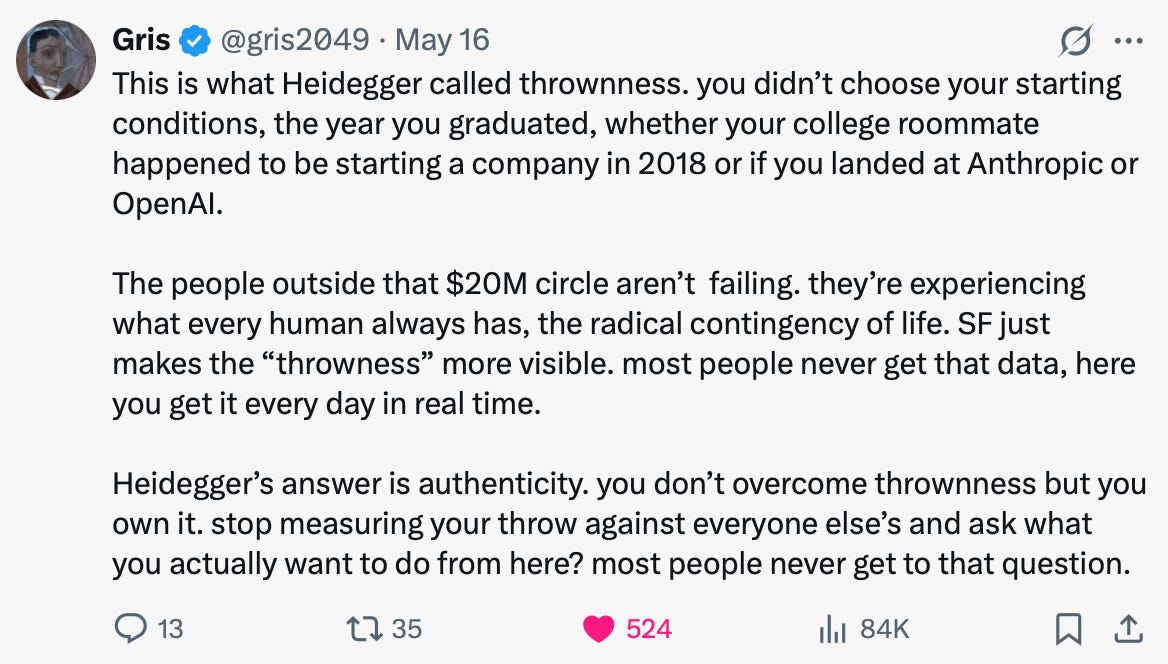
And that’s what characterizes what’s going on in many of us. We are trying to look for the verdict on who is behaving how in the AI craze. Hype! Enthusiastic! Blocking. Waiting! Overwhelmed (all of us!?). The fun point is, though: we are going through a collective moment of thrownness and the bewilderment that it causes in most of us.
You didn’t choose your starting conditions. You didn’t choose the year you graduated, or whether your college roommate happened to be starting a company in 2018, or whether you walked past the door of an AI lab in 2023 when it was open. The people outside that wealth circle aren’t failing. They’re experiencing what every human being always has — the radical contingency of life. The San Francisco Petri dish makes this unreal, very improbable throw of the fate that AI is, unusually visible. Most people never get that data. But now here, we are, these days we get it every day, in real time.
Heidegger’s answer, the reply went on, is authenticity. You don’t overcome thrownness. You own it. You stop measuring your throw against everyone else’s and you ask what you actually want to do from here.
I read that, then I went and looked up Heidegger’s original word and concept in German — Geworfenheit — because I was afraid that English flattens it. And it is so exactly to the point that I want to take it seriously and expand on it, first personally, then structurally. What is happening in that thread is happening to all of us. We have been thrown into this world, into this moment, and we did not get much of a vote.
Geworfenheit
The word comes from Being and Time, 1927. Heidegger’s claim is deceptively simple. To exist as a human being is to find yourself already underway — in a world, a body, a language, a family, a class, a historical moment — none of which you selected and none of which you were consulted about. You are, in his words and concept, thrown into the world. By the time you are able to ask “how did I get here?”, you are already here, shaped and in motion.
This is what he calls facticity. It’s not a / your failure. It’s not bad luck. It’s simply the basic condition. The “givens” of your life are not a verdict on you, because you weren’t in the room or even asked when they were assigned to you.
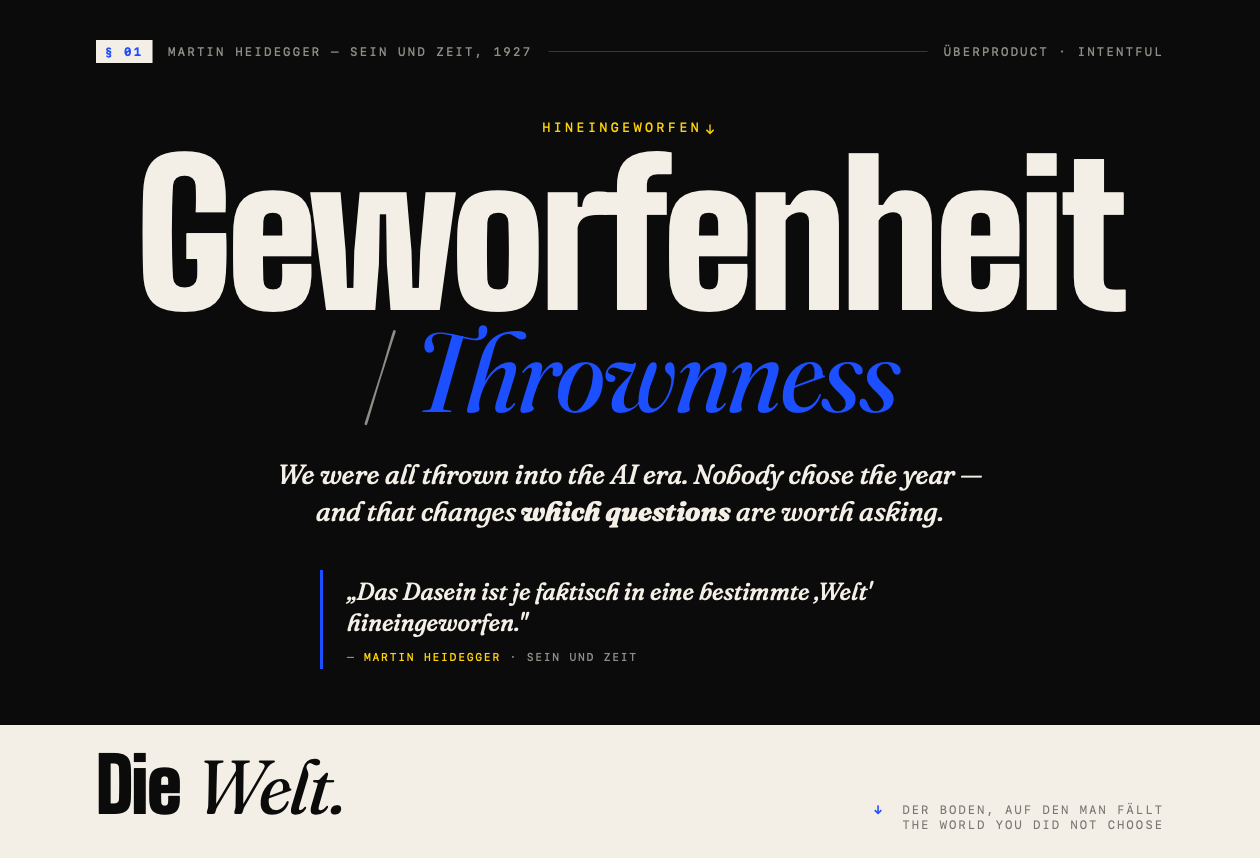
At the same time this means, and this is important: thrownness is not fatalism. Heidegger pairs thrownness with a twin concept — Der Entwurf, projection. To be thrown is also, always, to be throwing yourself forward. You are never just a product of your conditions; you are constantly relating to your possibilities, leaning into some future, interpreting what to do next. Thrownness without projection would be despair. Projection without thrownness would be a fantasy of the self-made person who chose everything. Real existence is both at once.
Which gives you a very precise division of labor. The options you have were not handed to you by merit. But what you do inside those options is entirely yours. Not partly. Entirely. That is the only thing that ever was.
In simple terms, The American Dream would be “your starting conditions" don’t matter” which is also expressed in the hustler’s “showing up is 80% of success”. While Heidegger would say “yes, for a few which were thron into the right starting conditions”. And the fatalist would say “why bother”, where I say: because inside your thrownness you have freedom and choice.
To give another very simple example: It is scientifically proven that the German education system has a specific hang for “thrownness” as it is pretty much stated that origin defines outcome to a large degree in the German school system.
I keep hearing the same sentence from people I work with, in different words. The skill set I spent fifteen years building lost most of its value in eighteen months. The 90/10 shock that Kent Beck formulated— ninety percent of what I was good at devalued, ten percent suddenly worth a fortune, and I don’t yet know which ten percent is mine. People with long, proud, hard-won professional histories. They are not lazy and they are not stupid. They were thrown. Behind all of our backs, the starting conditions are dealt / thrown again. The loom arrived. And the question they are actually asking — underneath the tooling questions — is what am I now?
The comparison is the herd
Notice the specific texture of the SF torment. It is not poverty. It is comparison. If I had joined that lab two years ago, I could retire. My roommate did. That person on my LinkedIn feed did. The pain is relational. It is the pain of holding your throw next to someone else’s and finding yours short.
Heidegger has a name for this too, and it is not flattering. He calls it das Man (the German “man”) — usually translated “the They,” or “the One.” It is the anonymous public self. The voice that says: this is what one does, this is what one should have, this is how one’s life should look by thirty. We mostly live inside “das Man” without realising it. We measure ourselves by a standard that belongs to no one and applies to everyone (depending on upbringing, probably), and we call the result an honest self-assessment.
It’s not. Measuring your own throw against the average throw is not an insight. It is the herd. “Comparison is the thief of joy” is the folk version of this; Heidegger gives it a structure and a diagnosis. The torment in that thread — am I gonna make it — is das “Man” asking a question on your behalf, in a voice youmigt think is your own.
You can see it everywhere. People scrolling LinkedIn with a low-grade nausea, watching the early movers, the ones who built a prototype on a train ride, the ones who already have agent systems running. Admiration laced with self-reproach: why didn’t I do that sooner — what does it say about me that I didn’t? That last clause is das “Man”. It converts a difference in throw into a verdict on your worth. It is doing this to you right now, probably, about something.
The opposite verdict is also happening. and it’s in teh form of one of the cheapest honeypots around currently: “I ams till thinking / writing / painting / doing myself. Agents will not come close to my thinking / writing / painting / doing”.
Angst is the doorway, not the disease
So the malaise — the frenetic, unsettled, can’t-focus feeling the thread describes, the exhaustion I hear from people who have gone through every emotional state with this technology, found it ridiculous then threatening then annoying then frightening — what is it exactly?
First instinct is to treat it as a problem to be solved. Manage it, medicate it, motivate it away.
Heidegger says something more useful. He distinguishes fear from Angst. Fear has an object — you fear a specific thing, a layoff, a deadline, a competitor. Angst has no object. It is the mood that comes over you when the whole familiar world goes quiet and slightly strange, and you sense, without being able to point at it, that the ground was never as solid as you treated it.
And here is his recommendation: Angst is not a malfunction. It is disclosive. It is the one mood that pulls you out of das “Man”, because das “Man” cannot answer it. But the herd has no comfort for groundlessness. Angst sets you in front of your own thrown, finite existence and says: this is yours, and no one else can live it for you.
The malaise is not the disease. It is the doorway. It is the moment the borrowed question — am I gonna make it — stops working, and your own question becomes audible underneath it. Most people, Heidegger says, never get to that question. They flee the Angst back into the herd. The frantic ones in that thread, doom-scrolling AI capabilities, “vibecoding their path to economic enlightenment” — that is the flight. Running back into das “Man” at high speed and calling it ambition.
Authenticity — Eigentlichkeit — is the alternative, and it is much smaller and less heroic than it sounds. It is not escaping your thrownness; you cannot. It is not reinventing yourself into a winner. It is one move: it is owning the throw. Taking the conditions you did not choose and saying these are mine to work with, and then asking the question das “Man” will never ask you — not “am I going to make it,” but “what do I actually want to do from here?”
That is the personal resolution. It is enough on its own. But it does not stay personal, because the thing producing the malaise is not personal.
AI is a thrownness machine
Now let’s step back from the San Francisco thread.
The mistake in the thread — the mistake in most of the takes about it — is to treat SF as exceptional. The unique gold-rush town, the warped bubble, the place where the divide is the worst anyone has seen. All true. But SF is not exceptional. It is just early. It’s the microcosm that mirrors us all.
The condition the thread describes — a skill set revalued overnight, a window that feels like it’s closing, real-time visibility into who got the better throw, winners / losers) a daily referendum on whether you are on the right side of history — that condition is not staying in San Francisco. AI is exporting it. To every knowledge worker, every consultant whose firm sells time and expertise, every design lead, every PM, every middle manager whose layer is being flattened for the “agentic era.” The layoffs are not a San Francisco story. The comparison feed is not a San Francisco story.
Here is the precise way to say it. AI did not make life more contingent. Life was always totally contingent — your birth, your decade, your openings, all thrown. What AI does is make the contingency impossible to ignore. It surfaces the throw. It takes the radical groundlessness that was always true and was always politely hidden by slow-moving careers and stable job categories, and it puts it on a screen, in public, in real time, updated daily.
AI is a thrownness machine. That is the structural fact. It is not destroying a stable world; it is revealing that the world was never stable, only slow. San Francisco simply put the spotlights on that existential issue first. Stakes and contrasts are simply higher there.
Stop scoring the throw
Which brings back the verdict reflex — the thing both feedback camps did — and lets me say what I actually think, and it is the part some people will not like.
Stop scoring the throw. Yours, and everyone else’s.
The person who joined an AI lab in 2023 was thrown. They will tell you it was vision and skill, and some of it was, and the decisive part was that the door was open when they walked past it and they were the kind of person, on that day, who walked through. Just that. The middle manager whose function is being hollowed out was thrown. The engineer whose craft devalued was thrown. And the Luddites were thrown.
Whan I mentioned the Luddites last week, I got interesting feedback. Do I mean their resistance was useless? And I was read as delivering a historical verdict: that what the Luddites did was wrong, that they were stupid to resist. No such edict from me, ever. I said one thing only: their resistance did not help them, and it did not stop the technology. That is not a judgment about their worth or their cause. It is a description of a throw. They were delivered into the arrival of the power loom exactly as involuntarily as a software engineer today was delivered into the arrival of the model. Judging the Luddites — heroes or fools — is none of my business and the same error as judging San Francisco’s winners and losers. It is the verdict reflex that people expect. But it’s neither required nor helpful.
“Tenure, intelligence, and hard work can be loosely correlated with outcomes.” That was a line from the thread, and a lot of weight is in the word loosely. In a normal decade, merit and effort track outcomes closely enough that the story “I earned this” and the story “I deserved better” both roughly correspond. In a transformation, they don’t. At all. The throw — the timing, the cohort, the open door — explains more of the variance than merit does. For a while. And that is causing the unsettling feeling.
Mentioning that sounds a bit cynical. It is the opposite. Cynicism is “it’s all luck, nothing matters, why try.” It’s not that. It is: the options are largely thrown, and what you do inside them is wholly yours, and confusing the two is what messes with people. With a lot of them, in fact, today. If you believe your outcome was pure merit, the first bad throw will break you. If you believe it was pure luck, you will never project at all. The accurate view — thrownness and projection, both, always — is the only one you can actually act from.
Caveat warning. The idea has a dark history and I don’t want to identify with it. Adorno spent a career attacking what he called the “jargon of authenticity” — the way Heidegger’s vocabulary watered down into a hollow badge people wore to feel deep, and worse, into a rhetoric of submission to fate and destiny. And he was right about it. So let me be exact about what I think authenticity is not. It is not about accepting your situation. It is not a doctrine of “everything is as it should be.” It is not a personality you perform. It is about one thing: owning your throw, refusing anyone’s verdict on it — including your own — and projecting from where you actually stand:
Deal with it
So here is the whole thing in one paragraph.
The thread about San Francisco made everyone ask for a verdict. The verdict was the mistake. The throw — who got rich, who got hollowed out, who moved early, who didn’t — was never the right thing to score. It was thrownness: the part of every life that was never up for a vote.
Personally, that means the situation is not your failure. It is Angst, and Angst is the doorway. It hands you back a question das “Man” stole from you: not whether you’ll make it, but what you want to do from here.
Structurally, it means AI is a thrownness machine. It is taking the contingency that was always total and making it visible to everyone, at the speed of a feed. San Francisco was just early, a test. The rest of us are being thrown into the same room now. All of us.
We were all thrown into the AI era. None of us chose the year. None of us were asked. The options were never in our hands — not which model arrives, not which skill keeps its value, not which door is open when we walk past it. What we do inside those options was always, entirely, ours.
Realizing this is not resignation. Resignation is about staying in the herd, scoring throws, asking the borrowed question. I am talking about the other thing. It is the only authentic position actually available — and, not incidentally, the only one that lets you do good work while everyone around you is still grading the throw.
We’re all collectively experiencing existential thrownness. Fine. Let’s deal with it. Make the best of it. Let’s not shrug. Well understood, without judgement, it is the whole answer.
Heavy stuff and interesting perspectives. Having gone through several groundbreaking evolutions and knowing SF … reminds me of a good quote (not sure from whom) .. „when the going gets tough the tough gets going“
There will be endless opportunities „man“ only has to find / define those