

The most strategic move any company can make right now is, ironically, a very tactical one: enable all of their workers — independent of role — in the new way of working with AI.
Not “explore AI.” Not “form a committee.” Not “wait for the enterprise version.”
Enable. Everyone. Now.
This is also the responsible thing to do. Your workers will depend on this skill in the future. Not enabling them now is negligence , you’re probably “waiting for the right moment.”
What makes me say this? Something happened! And there’s no doubt about it anymore.
The breakthrough is undeniable
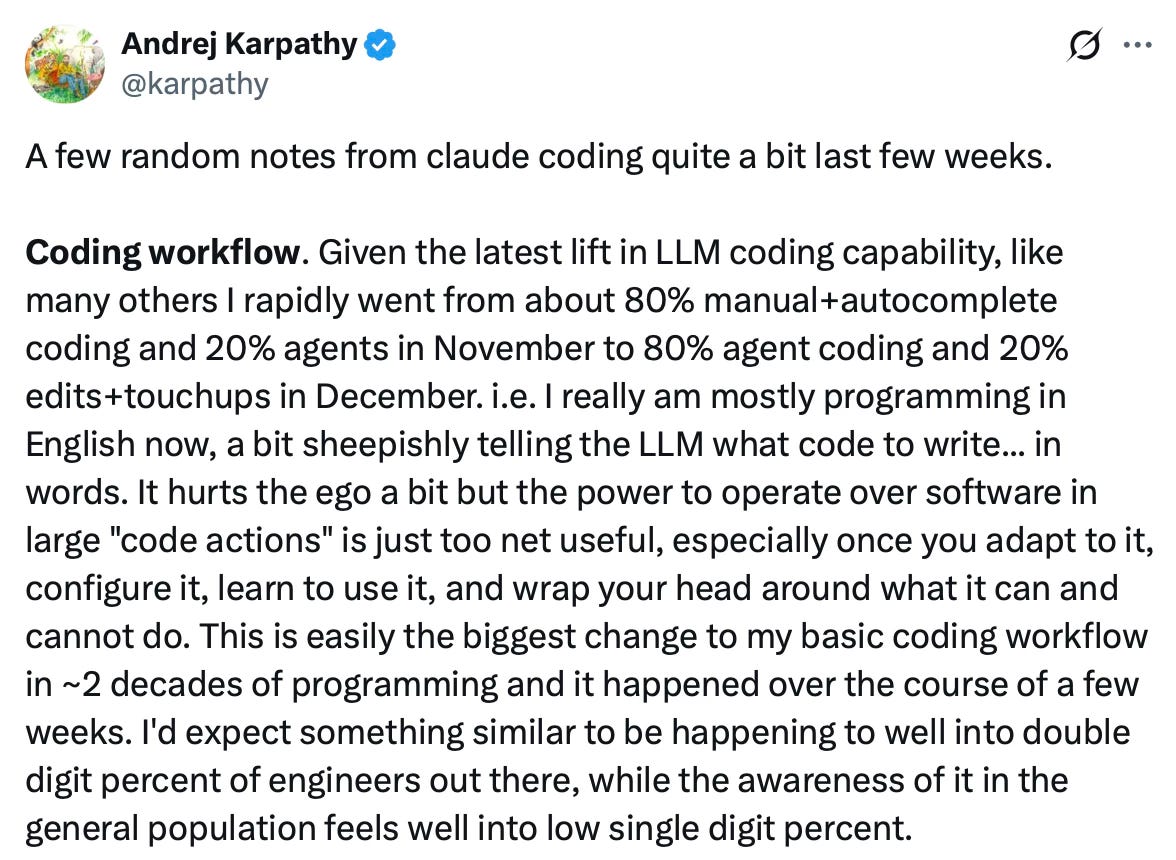
Andrej Karpathy — co-founder of OpenAI, former head of AI at Tesla, Stanford PhD — wrote in December: he went from 80% manual coding to 80% agent coding in a single month. He says AI still makes mistakes. It overcomplicates some things. Consumer LLMs are sycophantic. But going back? No way.
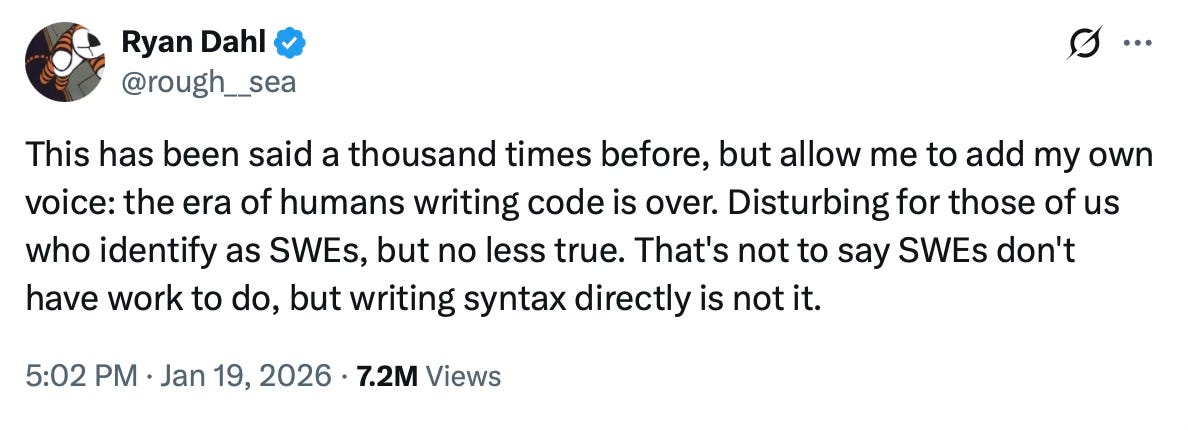
Ryan Dahl — creator of Node.js, the runtime that powers half the internet — wrote on X: “The era of humans writing code is over.” (see image at top)
I’m intentionally not citing the CEOs of big AI companies. Altman, Amodei, Huang — they have skin in the hype game. Karpathy and Dahl don’t. They’re builders. Practitioners. They are selling no AI, they are finding out how to work with for us. They are high level users, looking into the future. When they say the game has changed, we can listen.
You can disregard the hype and still arrive at the same conclusion.
I’m running a free Zoom session next Wednesday, 25 February 2026, 9am Berlin time where I set up Claude Code from absolute zero — empty folder, blinking cursor — to a running PM workflow in one hour. After the call, you receive all the resources and the video to follow along.
This is about more than code
Claude Code is the worst product name ever. The change is not for coders exclusively.
And right now, there are two bubbles out there.
Bubble one: People deep in agentic systems. Building workflows, automating the boring stuff, getting results that shock even themselves.
Bubble two: People firing off 20 ChatGPT prompts a day, thinking this is what AI can do. Frustrated by the results. Exhausted by the copy-paste cycles. Rebuilding context from scratch in every chat window.
The gap between these two bubbles is massive. And it’s growing every day.
Two moments that open minds
I’ve seen two specific moments that make people change perspective.
Moment 1: Seeing an orchestrated system in action.
Someone sees what happens when you set up an agentic system properly. From the ground up, with proper file structure, context and your real documents: strategy, interview notes, CEO briefings. No more copy-pasting between 20,000 documents. No more rebuilding your specific world in every chat window and cursing at the chat that it should casually remember. You set it up once. It knows your world. And it just works. Repeatedly.
Moment 2: Seeing the actual results.
This one is was harder to digest for me - and a bit of a soul crusher, honestly that cost me some vanity and time.
The real world example is a PRD, generated in a couple of steps from user interview notes. I assumes it’s generic. Surface-level. AI slop.
And yes, factually, a human could probably create a better one.
But when I start making a fair comparison to what actually happens in real life, it looks a bit different.
First, the AI-generated PRD is much better than you’d assume. Why? Because the context is there. Company strategy, goals, user research, constraints — all of that informs the output. The AI produces something with actual, surprising substance.
Humans could create a better one. But - surprise - they usually don’t. Time and effort. It’s the system, stupid.
What really happens in my life: I ask a PM when we can discuss the next product based on that research. Answer: two weeks. Then in 13 days, the evening before, he sits down and creates a version that barely survives our first conversation. Not great.
But two weeks ago, I already had a good, not great, PRD we could have discussed. We could’ve just started from there. Early friction instead of late mediocrity. Better results earlier, less risk later.
Same story everywhere. Evaluating features. Strategic review of a roadmap. Detecting drift between what the CEO wants and what you’re actually delivering. None of the AI results are perfect. But always good enough to start the discussion earlier and get to the relevant friction early and spot on.
The surprise: AI is better at abstract than you think
Here’s what really caught me off guard. The more strategic the topic, the better AI seems to perform. That takes the last bit of myth and human vanity out of the system.
A lot of the abstract soul-searching - weeks of debating the right wording - is vanity. The minute details make less of a difference than we think. They’re just vibes. The people on the work floor want to know what to do. Indicating the direction is good enough.
As Karpathy says: the main effect isn’t speedup. It’s expansion. You suddenly do things you wouldn’t have done because they weren’t worth the effort before.
That’s exactly what I’m seeing on the PM side. The work doesn’t simply get faster. The scope of what’s possible changes. You can now actually be more strategic.You can work talk to stores more and be more strategic. Everything we ever wanted. “Gestalten statt Verwalten” - my point since ten years. And it’s coming.
In fact, there’s little excuse left.
One hurdle remains
Even when both moments happen — when people see it and believe it — there’s still one last, huge wall that people run against:
Setting up your own system from zero. Empty folder to organized files. Terminal running. First agent executing. Spending that first hour. Getting comfortable. Creating the habit.
That’s where a lot of people are not simply getting stuck, but they don’t even get started.
But here’s the relief: it’s not hard. It’s only unfamiliar.
What this means for companies
Back to the top. The good news: the benefit is mutual.
The company gets more output, better quality, faster cycles. The workers get a skill that will define their career for the next decade.
How often does that align so nicely?
Not enabling your people now isn’t cautious. It’s negligent. The “right moment” was a few months ago. The second-best moment is now.
I’m running a free Zoom session next Wednesday, 25 February 2026, 9am Berlin time where I set up Claude Code from absolute zero — empty folder, blinking cursor — to a running PM workflow in one hour. After the call, you receive all the resources and the video to follow along.