The current environment makes everyone dizzy, and the temptation to simply fall for the next “opportunity” is high. FOMO is even higher. What if I don’t follow along? It’s so high that no one knows where the huge AI bet is ending. It’s huge, but the final payoff is uncertain: Will it be an insane fortune or another Second Life? Probably we will end up in the middle. The bubble might burst a bit, but a ton of good use cases remain after the storm.
Factors: Macroeconomic volatility or even downturn in which no one decides and buys. This is contrasted with the relentless pace of AI disruption and insanely accelerated geopolitical shifts. This has fundamentally altered the nature of strategy. The default response of organizations is often one of strategy-by-panic: an immediate, existential temptation to give up all former plans and rebuild from the ground up.
Thanks for reading The Intentful Company! Subscribe for free to receive new posts and support my work.
Or, the wave of AI adoptions:
ChatGPT wrapper: “We need something AI.”
Surprise: No customer value created.
Realization: Real customer value is more than simply throwing AI on your product.
The chase: Agentic dream, the vibe coding flash… you name it.
It’s easy to lose your way.
This impulse for radical, untethered change is the source of strategy nausea. A desperate pursuit of speed that ironically results in paralysis: The organization loses its ability to distinguish between signal and noise. Everything is noise. Value is hiding in plain sight, and the goal—who we are—is covered in dust. Hard to remember. The vision is dying on a graveyard of wisdom in our documentation system. Instead of giving direction, we sacrificed our hard-won identity for market fashion and pressure.
The core thesis of resilient strategy is counter-intuitive and dialectic: Strategic speed is achieved not by eliminating stability, but by doubling down on it. To adjust quickly and coherently, you must first preserve and protect your core identity.
Beyond the read: Mastering Strategy Execution
The principles and insights expressed here at “The Intentful Company” form the philosophical basis for my 12-week Blended Learning format: The Strategy Collective.
If you are ready to move from reading about strategy to owning it, the Collective is designed to give you a quick start in execution, deep insights into anchoring this role within your organization, and the path to becoming the go-to expert on this topic within your job environment and career.
The Format: Highly curated content, self-study modules, and small group coaching calls.
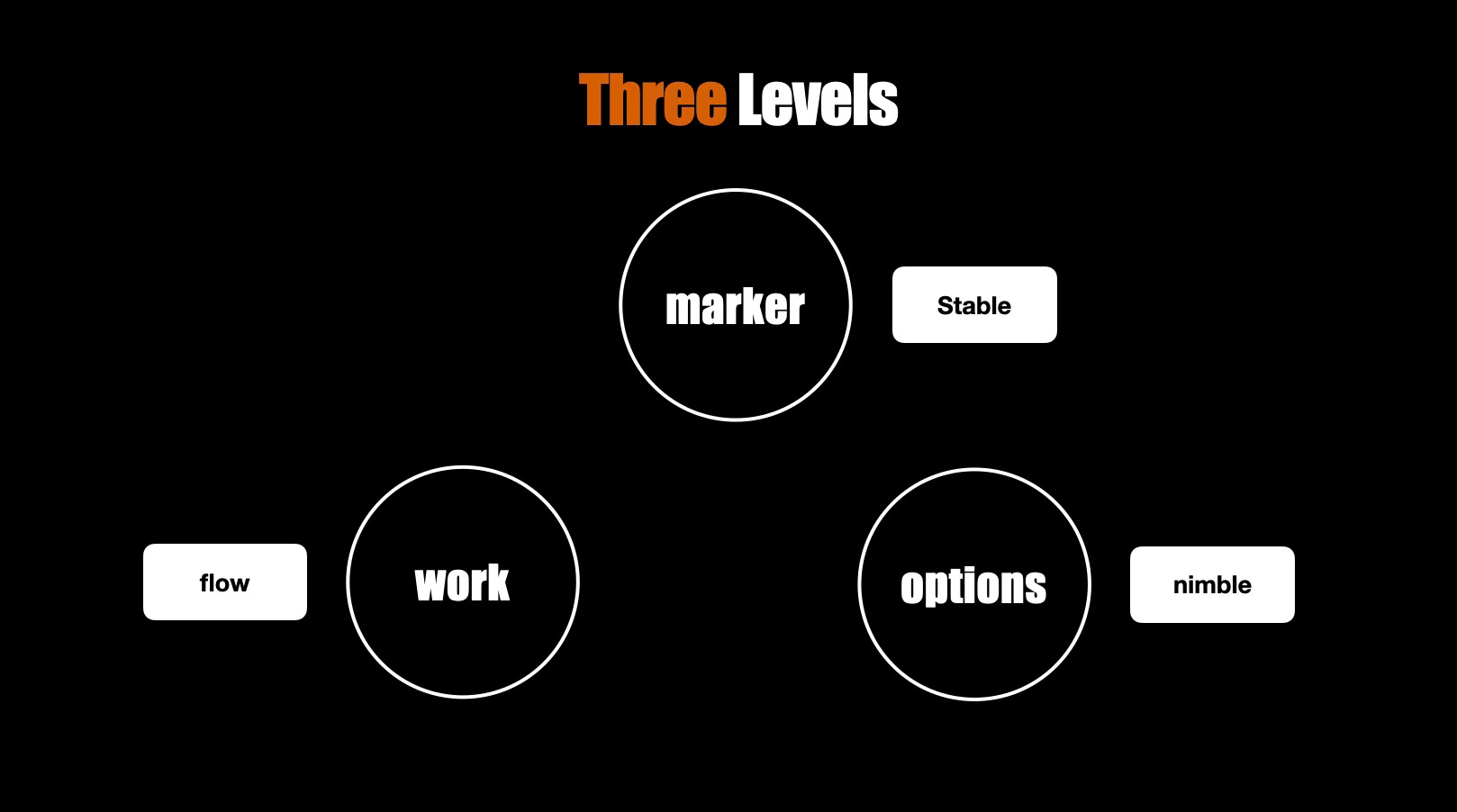
Any good strategy (framework) does this, but the property of balancing inertia and nimbleness is a first-class citizen of my MOW Framework (Markers - Options - Work). It provides a system necessary to manage this eternal tension between organizational inertia and market agility. It segments your strategy into three constantly coherent, interconnected layers, each operating at a different velocity:
1. Markers (Identity and Purpose)
The Marker represents your organizational identity, core purpose, and long-term positioning. It answers the question: Who are we, and why do we exist? Who are we and who are we not? What is our Identity?
The Marker’s most essential property is Inertia (Trägheit). Markers are slow, by definition. Thus, they must be difficult to change, and only adjusted in the face of existential necessity, not in response to simple quarterly market swings. The Markers are your strategic anchor; they are the gravitational center required to ensure all quick reactions are still heading toward the same destination. An organization that frequently changes its Marker is one that has abandoned strategy entirely.
Example: Apple does not change its identity on a yearly basis following some trend. They changed from Apple Computers to Apple once, signalling that computers are not the focus anymore, while becoming a personal device and digital service behemoth.
Markers can easily be understood by looking at a person. What makes me me? I was always a sportsman, MTB rider, runner. My kids changed that and my identity. While I still did some sports on the side, I did not identify as a sports- but as a family man. Now, that my kids grew older, I changed back to sportsman, although on a different level: more focusing on health than performance and competition. My identity defined what I am doing. The ways to express my identity are the options I have. As a sportsman, I now do workouts 5 to 6 times a week again. Habit follows identity. But I can’t follow all of them. I need to choose.
2. Options (Paths and Possibilities)
Options represent the concrete, mid-term paths and strategic bets designed to strengthen or realize the Markers. This is where Product Strategy lives.
In contrast to Markers, Options must be Nimble (Flink). They should be generated and evaluated as a portfolio of potential pathways, adhering to the principle of low downside, high upside. Strategic maturity is profoundly visible in the quality and agility of the Options layer. It involves treating significant resource investments not as locked-in expenditures, but as Real Options—investments that retain the right, but not the obligation, to pivot or scale based on rapid validation.
Hint: Options management well done in hindsight looks like master strategy. In fact, no one creates a strategy that predicts the future, and thus is a five-year masterpiece. Great strategy is always the whole of committing to options in the direction of our Markers, one by one. No one option will be winning. It is the cumulative effect of realizing the right options piece by piece that creates value.
3. Work (Flow and Execution)
The Work layer is the daily, operational process required to execute and realize your current, validated Options. It includes all agile (or non-agile) practices (Scrum, Kanban, etc.) and execution streams.
The primary objective of Work is Flow (Fluss). This layer must operate at maximum speed and efficiency. Crucially, the Work is not simply “doing stuff”; it is the mechanism of execution that validates the Options. Work provides the rapid feedback loop necessary to determine which Option should be scaled up (reinforcing the Marker) and which should be discarded (preserving resources).
Engine of Coherence: The Cost of Incoherence
The MOW Framework makes coherence a first-class system and helps to design and test for coherence at all times. The three layers are not organizational silos; they form a tightly coupled, closed-loop system of communicating vessels.
Work realizes the Options.
The realization of Options reinforces or strengthens the core Marker.
Note: The framework is agnostic towards the marker being a future vision or a wish for now on purpose. If you wish to express the wish for change, define your future markers as a friction to today’s state and choose options accordingly. If you want to reinforce who you are, have Markers remain even more stable and choose options according to that.
When the three layers M-O-W are falling out of alignment, when the Work being executed does not genuinely feed the current Options portfolio, when the Options are inconsistent with the core Markers, the organization suffers from incoherence. The employees sense that immediately. The resulting lack of clarity is killing sense of achievement, satisfaction with work and finally denies purpose. This is the root cause of the Strategy-Execution Gap and results in wasted resources, team fatigue, and an inability to respond effectively to external challenges.
Strategic discipline means meticulously protecting the slow-moving Markers from direct operational influence and ensuring dynamic alignment between Options and Work. Thus your organization gains the fundamental capacity to handle market disruption without losing its identity, ensuring that strategic speed is always true to the ultimate goal.
The idea of a stable core enabling nimble choice of actions is heavily influenced by the brilliant concept of Pace Layering by Steward Brand (which may be one of the next topics).
Thanks for reading this post of The Intentful Company to the end! This post is public so feel free to share it, if you find it valuable. It helps a lot!
Thanks for writing this, it clarifies a lot, especially how easy it is to chase shiny AI objects instead of focusing on real problem solving, though the potential is still imense.


Thanks for writing this, it clarifies a lot, especially how easy it is to chase shiny AI objects instead of focusing on real problem solving, though the potential is still imense.