

The PM discussion about AI in 2026 comes down to the same conclusion:
AI can’t do what we do because what we do is judgment, taste, the art of product.
Thinking about this deeply, the defense is actually an admission.
The scene: an experienced high quality PM tells me (and I concur) that autonomous agents in his work make no sense. Why? Because he needs to judge the results before he enters the meeting.
A developers code “simply” has “to work”, the PM has to convince.
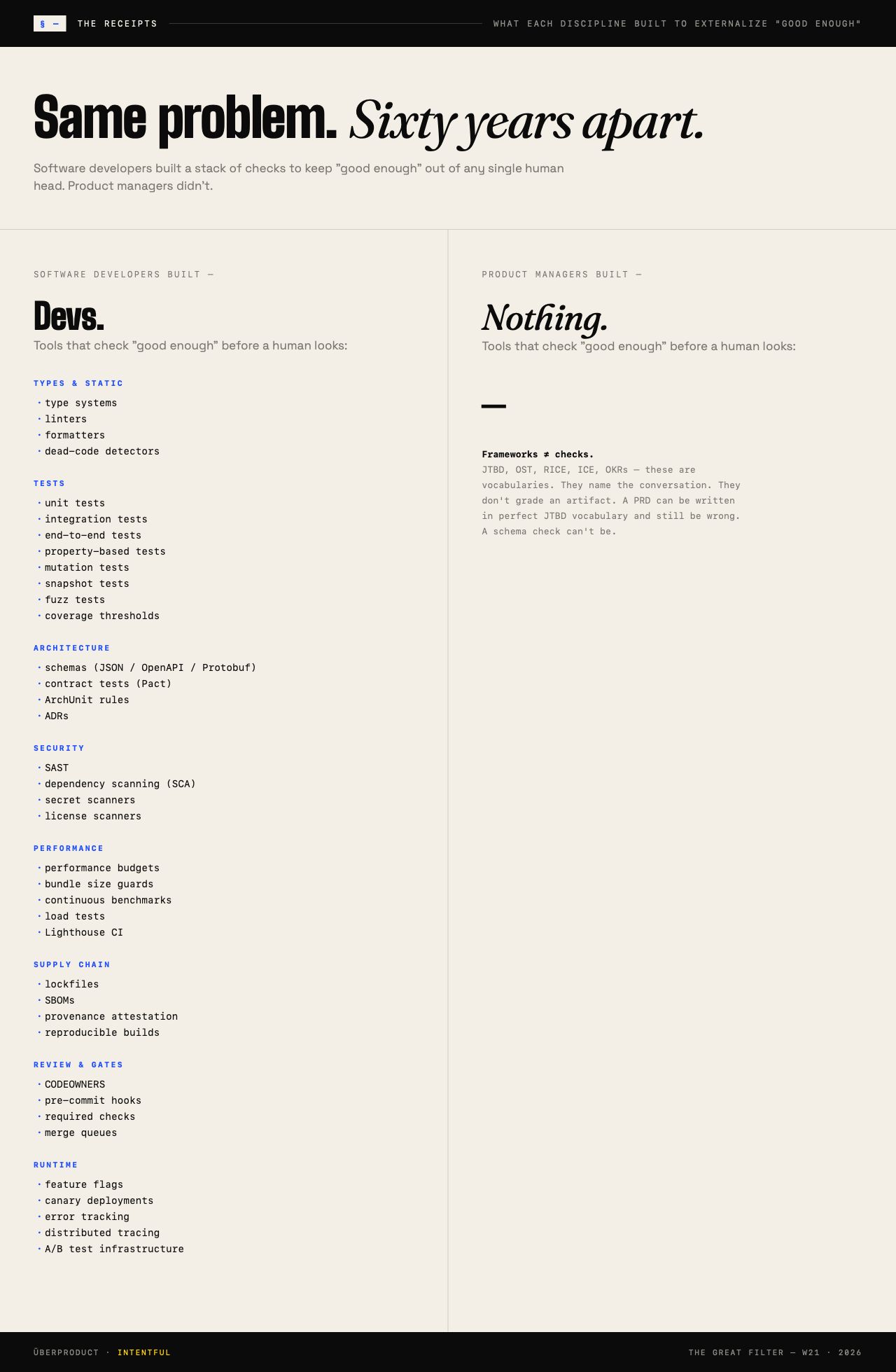
To make sure that their software works, devs have built tools since decades that automate verification steps.
As PMs, meanwhile, we can’t make up our minds: If the boss comes with opinion, we counter “data driven, science”. Once AI comes around the corner with data, we counter with “judgment, taste, art”.
The metric that makes a PM a good AI augmented PM is not “I use a ton of skills” but “I can describe what good looks like” and “I can describe how things are connected”.
If we had done this for years, rather than declaring our role is so different, so much more than a glorified project manager, we would have already developed the tools that make us even better with AI. That’ll be the next step. Not trivial skills that “write some PRD”, “do some market research”. And some are already figuring it out.
The infrastructure devs built
Software developers spent sixty years codifying the standards for “good” out of human heads and into machinery. Type systems. Test suites. Schemas. Linters. Formatters. ArchUnit rules. Performance budgets. Bundle size guards. Pact contracts. SAST. CODEOWNERS. Feature flags. ADRs. SBOMs. Each describing a piece of what the senior engineer used to have on their in their mind, and now lets them hand it over to an agent. When an agent ships code, fourteen layers of codified standards do their work before a human opens the diff. The “taste” is in the machinery. While it hurts the old school engineer, the ones embracing the genie are thrilled.
Product management did the opposite. We kept it all in our heads. We never had a clear body of knowledge, we never had a clear education path, most of us transitioned into the role from the side. We rebuilt from scratch with each new team. The literature? Give me a break. Marty Cagan is more aspiration than description of what works. “Empowered. Transformed. Inspired”. Cool, aspirational, but hardly something that helps steer an agent. We invented frameworks that sounded like standards — JTBD, OST, RICE, ICE, OKRs — but they were vocabularies. A PRD can be written in perfect JTBD vocabulary and still be wrong. A schema check can’t be.
The same job. Twenty-five years of not doing it.
When a PM says AI can’t replace what we do because in the end all of it is judgement or taste, experience, probably 10% are. The other 90% are laziness.
→ Our standards were never written down.
→ They were never written down because we never made them rigorous enough to write down.
→ Only one or two people per team know them.
→ When they leave, the standard leaves.
→ When AI arrived, the standard couldn’t be handed over because there’s nothing to hand.
→ Therefore, AI can’t do what we do.
And while every word is true, every word is also an admission.
And, yes, while there is taste and judgement needed: How many people in the company need that taste and judgement?
Basically, product never decided if it wants to be art or science and we weasel around that decision and use whatever fits us. Now that bites us in the back.
The dev version of the same sentence, that AI can’t replace what we do, there’s an architectural piece, a correctness piece, a design piece, is backed by ArchUnit, the type system, the test suite, formal review. It’s based on systems and their boundaries. And, yes, of course, also developers feel sorrow over the lost value of 90% of their skills. But our “this can not be replaced” is based on no work and on no system. The moment we let Claude Code run over our context, it finds a ton of noise next to the signal and we spent a lot of time creating that noise. and most of it is vanity, not value.
Can it be finished? No way. Devs are sixty years in and still do reviews in their heads. Finish is not the goal.
The question is: did we start.
We didn’t.
And now we use the not-starting as our differentiator.
Human exceptionalism as cover
We didn't write it down. So we pointed at the people who knew it. They became the brand. Judgment. Taste. Vision. Art.
The ethereal words work as the moral high ground because they can’t be checked. A standard that can be described can be checked and then enforced, automated, transferred, scaled, and held against the holder.
If you don't describe it, you can't be checked. You’re hiding.
Human exceptionalism in product management is basically the cover we’re hiding behind. You can’t audit us, because what we do isn’t auditable. The unauditable part is a fact about us, not about the work. The work is auditable. We never built the audit.
I call BS. So much of what we do can be checked. So many implicit decisions can be made explicit, are detectable by AI. So little of what we create is signal, so much is noise. And the AI is really good in figuring that out. Most of the noise is vanity, wording that does not matter and an excuse.
The cultural reflex
Software developers treat a lack of formal definition as a problem to solve. As Feynman says about social sciences, he would say about us: “They don’t do the hard work”. We don’t have a way to check this, let’s build one. That has brought progress to a thousand industries. It also makes us more repeatable. Hmm.
Product managers treat a lack of formal definition as evidence of cognitive superiority. You can’t check this, it’s judgment. That sentence has shipped careers forward, not much else.
The difference between the two disciplines is not tech but culture. Devs externalize and scale. They want to automate. PMs internalize and gatekeep. As long as the work was rare and slow, gatekeeping was a nice position be in. AI produces a hundred plausible artifacts a day. Gatekeeping doesn’t help any longer. The Mexican standoff between the disciplines that AI triggers, won’t allow for that “moat”. Devs never saw the value of esoteric, elitist PM talk. Their patience will get bigger. Will the product engineer come from the dev or the PM side? I guess both, but only those who embrace “describability”.
Every “we need judgment” sentence is an infrastructure question
There’s a translation available, and almost no PM team is using it.
“We need judgment about what a strong PRD looks like.” → A checklist, a worked-example library, a counter-example library, a schema-of-thought. It can be built in a quarter. A check against decisions, strategy, available tech, customer knowledge etc. None of that is abstract and none of that can not be described.
“We need taste about what counts as a real customer insight.” → A definition of evidence, a magnitude threshold, a recovery test (can the customer’s actual phrasing be reconstructed from the synthesis?), a rejection library. It can be built in a quarter.
“We need judgment about which strategic options to pursue.” → A set of forced explicit trade-offs, a reversibility classification, a pre-mortem template, a stakeholder-room simulator. Can be built in a quarter.
None of these need AI to be useful. But all of them make AI useful when it arrives. And they boost you, who made them describable. They make the team better in the meantime. They make the senior PM scalable instead of bottlenecked.
The ultimate PM skill therefore is not taste but to be able to describe what we hide behind taste.
The reason most teams haven’t built any of this isn’t that it can’t be built. It’s that building it would expose how much of the previous “judgment” was vagueness. Codifying a standard forces a team to find out it never agreed on it. Vagueness is comfortable. Standards are expensive. Most teams choose comfortable. Then they call the comfort taste.
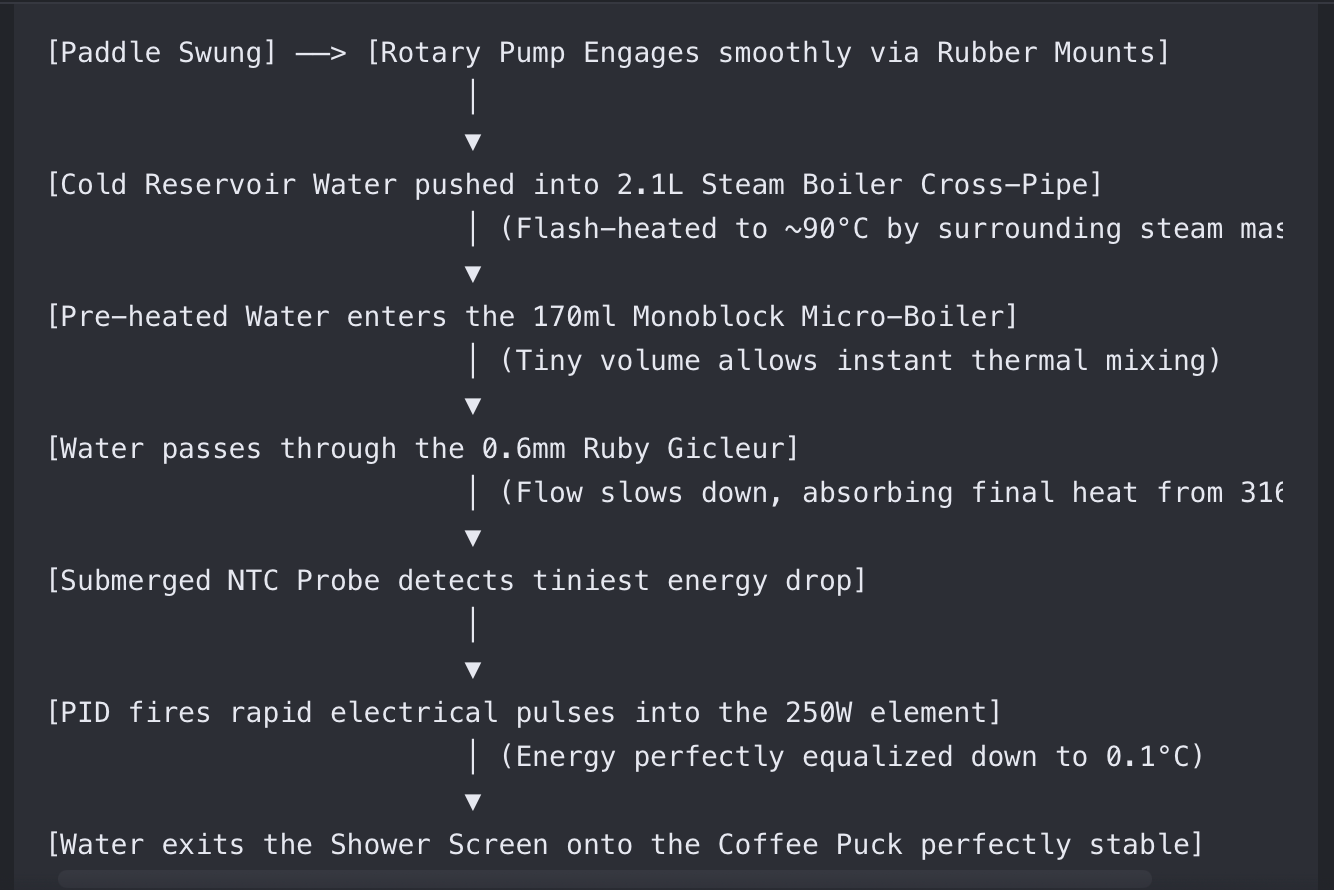
To be concrete: My insanely great Marzocco machine is nit great because an esoteric PM has singular judgment and taste, but because the Marzocco has accumulated ca. a hundred patents that keep the temperature more constant than in other machines during brewing and a design language that is not esoteric but very well described. None of that is abstract taste. And if you talk to the people at Marzocco they might not tell you everything but they can describe every little bit that makes their machines unique. a Marzocco looks like art but is hard science and engineering.
The guild defense
The political content of the taste discourse in 2026 is straightforward.
PMs claiming taste, judgment, art against AI are mostly not protecting craft. They’re protecting their position as the only person in the room who knows what good looks like. AI threatens the monopoly, not the work.
A team with a codified PRD standard doesn’t need the senior PM in every PRD conversation. A team with a customer-insight rejection library doesn’t need the senior PM in every synthesis review. A team with a strategy-doc schema doesn’t need the senior PM as the single authority on whether a strategy doc is finished.
For the team (and for the company) that’s improvement and progress. For the discipline that’s improvement. For the individual whose career was based on being the gatekeeper and the bottleneck it isn’t.
The taste claim defends the gatekeeper, not the work and certainly not the product. AI doesn’t care about gatekeepers, which is why the defense becomes useless.
Stop claiming what you don’t have
The change is small and can be done now.
Stop saying “we need judgment” to protect yourself from what AI will bring along anyway. Start saying “we need a checklist for this artifact type that captures what we used to mean by judgment.” Build it. Check the agent’s output against it. Update it when the check misses things.
Devs externalized their judgment over decades until judgment was the test passed. That’s not a loss of taste. That’s taste codified. The senior engineer’s taste is written into the test suite, scaling to a thousand engineers and ten thousand agents.
We can do this. We have to. Others will do it without asking. It’s not that hard.
The reason it hasn’t been done is institutional, not technological. The institution preferred to be indispensable rather than scalable. AI made that preference unaffordable.
When Brian Chesky trusted “product” as a disciple and gave up after not seeing the results, that was a first sign of PMs not wearing clothes. It doesn’t matter that much if Brian Chesky was right in every detail. But AI will bring the verdict.
“We need judgment” is a confession. Treat it as one. Build the thing the confession admits we never built.